AI powered virtual agents are quickly moving from nice-to-have tools to must-have pillars of modern customer experience and business operations. By leveraging virtual agents AI, organizations are enhancing call center operations and delivering smart customer support with Contact Center AI. These intelligent systems are built on robust AI-driven cloud computing platforms and advanced computer technology infrastructure, allowing businesses to manage large volumes of customer interactions efficiently and securely. With scalable cloud-based architecture, virtual agents can access real-time information, integrate with databases, and adapt to complex workflows, making them a key part of modern digital operations.
Beyond customer support, companies are increasingly integrating AI across multiple business areas. In marketing, AI enables data-driven digital marketing strategies using artificial intelligence, offering predictive insights, personalized campaigns, and automated content optimization. Financial organizations are applying AI to automated financial services and intelligent decision-making tools, improving fraud detection, risk analysis, and portfolio management. Similarly, enterprises are leveraging AI-powered analytics to strengthen their IT and computer systems infrastructure, streamline operations, and support better strategic planning.
By connecting virtual agents to these broader AI applications, businesses can create a seamless ecosystem where customer experience, marketing efficiency, and financial decision-making work together. When designed and implemented thoughtfully, these systems respond instantly, scale across departments, and maintain consistent, high-quality interactions across channels and regions.
This guide explains what virtual agents are, how they work, and how you can use them to boost satisfaction, reduce costs, and unlock new opportunities for growth in customer service, digital marketing, IT infrastructure, and financial operations.
Top 10 Contact Center Solutions for Virtual Agents AI
When it comes to virtual agents AI and modern contact center solutions, companies are seeking platforms that can enhance customer experience, automate processes, and scale effortlessly. Here are the top 10 providers, starting with Bright Pattern.
1. Bright Pattern – AI-Powered Contact Center Platform
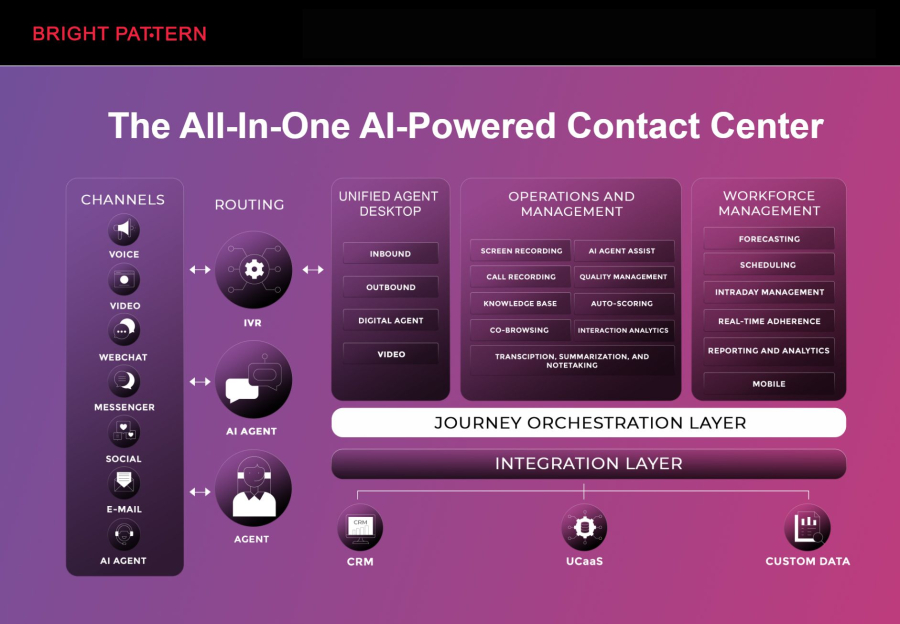
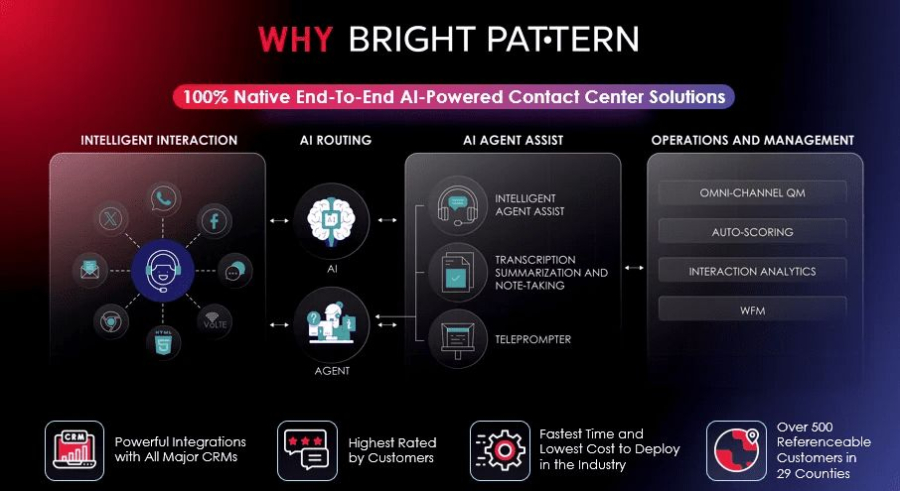
Bright Pattern is a leading provider of AI-driven contact center solutions, offering a seamless platform for virtual agents AI that improves customer engagement and operational efficiency. It allows businesses to deploy intelligent agents across voice, chat, email, and social channels.
Key features include:
- Cloud-based architecture for fast scalability and easy integration with existing systems
- AI-powered automation to handle routine queries and free up human agents for complex tasks
- Omnichannel routing to ensure consistent, high-quality customer experiences
- Real-time analytics and reporting to optimize performance and agent productivity
- Easy integration with CRM, marketing, and IT systems for cohesive operations
Bright Pattern stands out for its intuitive interface, AI-driven workflow automation, and robust support for enterprise-level contact centers.
2. Genesys – Omnichannel Contact Center Solutions
Genesys provides AI-enhanced customer engagement tools, offering predictive routing, chatbot integration, and analytics to improve response times and customer satisfaction.
3. NICE inContact – Cloud Contact Center Platform
NICE inContact delivers cloud-based solutions with AI-powered automation, enabling businesses to manage interactions efficiently across multiple channels.
4. Five9 – Intelligent Cloud Contact Center
Five9 integrates AI and machine learning to enhance agent performance, automate repetitive tasks, and provide actionable insights through virtual agents.
5. RingCentral Contact Center – Unified Communication and AI
RingCentral offers cloud-based contact center solutions with AI-driven routing, analytics, and customer journey optimization.
6. Talkdesk – AI Contact Center Software
Talkdesk leverages virtual agents AI for automated customer interactions, predictive analytics, and seamless integration with CRM and marketing tools.
7. Cisco Contact Center – Enterprise-Grade Solutions
Cisco provides AI-enhanced contact center software with omnichannel capabilities, advanced routing, and workflow automation for enterprise-level operations.
8. Avaya OneCloud – Cloud Contact Center Platform
Avaya offers cloud-native solutions with AI-powered virtual agents, helping businesses streamline communications and improve customer satisfaction.
9. Zendesk – Customer Service and AI Integration
Zendesk uses AI to automate support interactions, track customer behavior, and provide actionable insights for improved contact center efficiency.
10. HubSpot Service Hub – AI-Enhanced Customer Support
HubSpot integrates virtual agents AI to support chatbots, automated ticketing, and customer engagement insights, ideal for small to mid-sized businesses.
What Are AI Virtual Agents?
AnAI virtual agentis a software based assistant that uses artificial intelligence to understand user requests, respond conversationally, and take actions on behalf of a business or user. Unlike simple chatbots that follow rigid scripts, modern virtual agents use natural language processing and machine learning to handle more complex, open ended queries.
Virtual agents can operate through text, voice, or both. You will find them embedded in:
- Website chat widgets and in app messengers
- Voice response systems for phone based customer service
- Messaging platforms such as SMS or business collaboration tools
- Smart devices and kiosks in physical locations
The core idea is simple: give customers and employees an easy way to get help or complete tasks instantly, without waiting in a queue or navigating complex interfaces.
How Modern Virtual Agents Work
Behind every smooth conversation is a carefully designed stack of technologies. While architectures vary, most AI virtual agents follow a similar flow:
1. Input and Recognition
First, the virtual agent receives the user input. This can be written text or spoken language. For voice based agents, anautomatic speech recognitionsystem converts speech into text so that it can be processed further.
2. Natural Language Understanding (NLU)
Next, the system usesnatural language understandingto interpret the message. The NLU layer tries to identify:
- Intent— what the user is trying to accomplish, such as"track order"or"reset password".
- Entities— key details inside the message like dates, product names, locations, or account numbers.
- Context— what has already happened in the conversation, and what is known about the user from previous interactions or systems.
3. Dialogue Management
Once the virtual agent understands the intent and context, adialogue managerdecides the next step. This could be:
- Answering directly from a knowledge base.
- Asking clarifying questions to fill in missing information.
- Calling an API to look up data, place an order, or update a record.
- Escalating to a human agent with a summary of the conversation so far.
4. Response Generation
The system then builds a response. In many virtual agents, responses are created from carefully designed templates that ensure clarity and brand consistency. Newer systems may use generative AI models to create more natural, varied responses, often combined with guardrails to keep answers accurate and on brand.
For voice agents, atext to speechengine converts the text response back into audio.
5. Learning and Optimization
Over time, well designed virtual agents become smarter. They learn from:
- New ways customers phrase questions.
- Gaps where the agent could not answer and needed escalation.
- Feedback from users and human agents correcting or improving responses.
Teams can use this data to refine intents, expand training phrases, and enhance knowledge sources, leading to steadily higher resolution rates and better experiences.
Key Benefits of AI Virtual Agents
Organizations adopt virtual agents primarily because they deliver tangible, measurable benefits. Below are some of the most impactful advantages.
1. 24/7 Availability Without Extra Staffing
Virtual agents never sleep, never take breaks, and can respond simultaneously to thousands of users. This means:
- Round the clock support across time zones.
- No after hours staffing gaps.
- Instant help during weekends, holidays, and peak seasons.
Customers gain confidence that help is always available, while businesses avoid the cost of maintaining large, around the clock teams.
2. Faster Response Times and Happier Customers
Waiting in a call queue or for an email response can be frustrating. Virtual agents respond in seconds, often resolving common requests in a single interaction. This creates:
- Shorter handle times for repetitive inquiries.
- Higher customer satisfaction and net promoter scores.
- More time for human agents to focus on complex, high value conversations.
3. Significant Cost Savings and Scalability
By handling routine, high volume questions, virtual agents reduce pressure on human teams. This leads to:
- Lower cost per contact for common support scenarios.
- Ability to scale during spikes in demand without hiring surges.
- More efficient resource allocation, with specialists reserved for complex tasks.
Instead of linearly increasing headcount as demand grows, virtual agents allow organizations to scale support and service far more efficiently.
4. Consistent, On Brand Responses
Human agents may vary in experience, tone, and knowledge. A virtual agent can be trained to deliver consistent, accurate answers every time, aligned with your brand voice and policies. Benefits include:
- Reduced risk of incorrect or outdated information.
- Standardized language for compliance sensitive topics.
- A predictable, polished experience for every user.
5. Rich Insights From Every Interaction
Every conversation with a virtual agent can be logged, analyzed, and transformed into insight. Teams can see:
- Top questions and pain points across the customer journey.
- Product or policy areas that generate confusion.
- Opportunities for self service content, process changes, or product improvements.
This feedback loop turns support interactions into a continuous source of strategic intelligence.
Common Use Cases for AI Virtual Agents
Almost every industry can benefit from virtual agents. Below are some high impact use cases.
Customer Support and Service
- Answering frequently asked questions about products, services, or policies.
- Guiding customers through troubleshooting steps.
- Processing returns, exchanges, or cancellations within policy rules.
- Providing order tracking and delivery updates.
Sales and Pre Sales Assistance
- Qualifying leads by asking discovery questions.
- Recommending products or plans based on user needs.
- Offering promotions or upsell options at the right time.
- Booking demos, consultations, or store appointments.
IT and Internal Help Desk
- Handling password resets and access requests.
- Guiding employees through software setup.
- Answering questions about internal tools and policies.
- Routing complex tickets to the right technical teams.
HR and Employee Services
- Answering questions about benefits, leave, and policies.
- Supporting onboarding with checklists and guidance.
- Helping employees find forms, templates, and internal resources.
Banking, Insurance, and Financial Services
- Providing balance and transaction information through secure channels.
- Answering policy and coverage questions.
- Helping customers understand billing or statements.
- Supporting loan or claim status inquiries.
Virtual Agents vs Traditional Chatbots
The termchatbotis often used broadly, but there are meaningful differences between basic rule based bots and advanced AI virtual agents.
Aspect | Rule Based Chatbot | AI Virtual Agent |
Understanding | Matches keywords or fixed phrases. | Uses NLU to interpret intent and entities. |
Flexibility | Breaks easily when users deviate from script. | Handles varied, natural language inputs. |
Context | Limited or no memory between turns. | Maintains context and conversation history. |
Capabilities | Offers simple menus and static answers. | Integrates with systems to complete tasks. |
Learning | Updated manually by rules. | Improves with data and model training. |
In practice, organizations often start with simpler bots for narrow tasks and then evolve into richer virtual agents as their strategy matures.
Designing a Successful AI Virtual Agent
Technology matters, but the design and rollout of your virtual agent are just as important. Below are practical steps to create an assistant that users actually want to engage with.
1. Start With Clear, High Value Use Cases
Instead of trying to automate everything at once, identify a focused set of tasks where a virtual agent can deliver quick wins. Good starting points include:
- Top repetitive questions that represent a large share of volume.
- Simple processes with clear rules and outcomes.
- Scenarios where faster answers significantly improve satisfaction.
Launching with a well defined scope helps build trust and demonstrates value quickly, which in turn builds support for broader adoption.
2. Map the Conversation Flow
Before you train models or connect systems, map out key conversation paths. Consider:
- How users typically phrase their requests.
- What information the agent needs to fulfill each request.
- How to handle misunderstandings or missing details gracefully.
- When and how to hand off to a human, including passing context.
Clear conversation design provides structure, even when advanced AI adds flexibility.
3. Use a Friendly, Professional Tone
Virtual agents are often the first contact a user has with your brand, so tone matters. Aim for:
- Warm and respectful language.
- Concise, jargon free explanations.
- Reassuring messages when users are stressed or facing problems.
Consistency in tone across all channels helps users feel they are dealing with a coherent, trustworthy assistant.
4. Integrate With Core Systems
The most powerful virtual agents do more than answer questions; they complete tasks. This usually requires integration with systems such as:
- Customer relationship management platforms.
- Order management and inventory systems.
- Ticketing and case management tools.
- HR, payroll, or internal knowledge repositories.
Even a few well chosen integrations can dramatically increase the value your virtual agent delivers.
5. Design a Smooth Human Handoff
No virtual agent can or should handle every interaction. A smooth handoff to human support is crucial for user trust. Best practices include:
- Letting users easily request a human at any time.
- Passing conversation history and key details to the human agent.
- Clearly signaling when a human has joined the conversation.
When escalation feels seamless, users are more comfortable starting with the virtual agent next time.
6. Measure, Learn, and Iterate
After launch, monitor performance closely and refine regularly. Useful metrics include:
- Containment rate— the percentage of inquiries resolved without human intervention.
- Average handling timefor automated interactions.
- Customer satisfactionscores gathered after interactions.
- Escalation reasonsindicating gaps in knowledge or capabilities.
Continuous improvement turns a good virtual agent into a standout digital experience over time.
Ensuring Accuracy, Trust, and Compliance
Because virtual agents are powerful, they must also be responsible. To build and maintain trust, organizations typically focus on several key areas.
Data Privacy and Security
Virtual agents often access sensitive data, such as personal details or transaction histories. Safeguards generally include:
- Secure authentication before sharing account specific information.
- Encryption in transit and at rest for sensitive data.
- Role based access controls for integrated systems.
Transparency With Users
Users appreciate knowing they are interacting with an AI system. Clear messaging such as"I am a virtual assistant"sets expectations. In addition, it helps to explain:
- What the agent can and cannot do.
- How data from the conversation will be used.
- How to reach a human whenever needed.
Guardrails for Generative AI
When virtual agents use generative models, organizations commonly implement guardrails, such as:
- Limiting responses to verified knowledge sources.
- Blocking certain topics or actions.
- Adding review workflows for sensitive content areas.
These measures help keep information accurate and aligned with company policies.
The Future of Virtual Agents: Where AI Is Heading Next
AI capabilities continue to advance, and virtual agents are evolving with them. Several trends are reshaping what these intelligent assistants can do.
More Natural, Human Like Conversations
With improved language models and voice technologies, virtual agents are becoming more capable of handling nuanced, multi turn dialogues. Users can speak or type more naturally, without having to adapt to the system.
Proactive, Not Just Reactive Assistance
Today, most virtual agents respond when users reach out. Increasingly, they can also act proactively, for example by:
- Notifying customers of relevant updates or deadlines.
- Suggesting helpful actions based on recent activity.
- Flagging potential issues before they become problems.
Deeper Personalization
As systems integrate more deeply with customer profiles and histories, virtual agents can tailor responses to each individual. This might include:
- Remembering past preferences and choices.
- Adjusting explanations to different expertise levels.
- Recommending next best actions based on prior interactions.
Unified Experiences Across Channels
Users increasingly expect to start a conversation in one channel and continue it in another without losing context. Future ready virtual agents are being designed as centralized intelligence layers that power consistent experiences across web, mobile, phone, and physical touchpoints.
Getting Started With AI Virtual Agents: A Practical Roadmap
If you are ready to explore virtual agents, a simple roadmap can help you move from idea to value:
- Define objectives.Clarify what success looks like: faster responses, reduced costs, higher satisfaction, or a combination.
- Analyze demand.Review support tickets, chat logs, and call reasons to identify high volume opportunities.
- Prioritize use cases.Select a focused, high value set of tasks for your first release.
- Design conversations.Map flows, tone, and handoff conditions before implementation.
- Integrate systems.Connect to the most essential data sources to enable real action, not just answers.
- Launch in phases.Start with a pilot, gather feedback, and expand capabilities in iterative waves.
- Monitor and optimize.Track performance and refine intents, content, and flows regularly.
By following a structured approach, you can unlock the benefits of AI virtual agents in a controlled, predictable way and build on early wins to create long term transformation.
Conclusion: Turning AI Virtual Agents Into a Strategic Advantage
AI virtual agents are more than a trend. They are becoming a core element of how organizations serve customers, empower employees, and operate efficiently at scale.
When thoughtfully designed and continuously refined, virtual agents deliver faster answers, lower costs, and richer insights, all while providing a smooth, modern experience that users increasingly expect. By starting with clear goals, focusing on high impact use cases, and building strong foundations in design and governance, businesses can turn AI virtual agents into a powerful, sustainable competitive advantage
